 Pickleball Mixer
Odd Number of Players in Pickleball: How to Rotate the Bye
An odd number of players does not stop you from running a pickleball tournament. The real challenge is not fitting 9 or 11 people onto the courts, it is spreading the bye rounds fairly across the whole evening, then ranking players who have not all played the same number of matches. Two separate questions, two different answers.
And good news to start with. Some odd headcounts are among the most balanced you can get.
What actually determines rest time
Contrary to intuition, it is not whether your headcount is even or odd that matters. A doubles match uses 4 players. With 2 courts, 8 players take the court each round. Everyone else waits.
So the real question is: how many players are left once the courts are full?
With 10 players and 2 courts, an even headcount, 2 people wait every round. With 9 players and 2 courts, an odd headcount, only one person waits. The odd headcount is the more comfortable of the two here.
What matters is the remainder of your player count divided by 4:
| Remainder | Players waiting per round | Comfort |
|---|---|---|
| 0 | 0 | Perfect rotation, nobody sits out |
| 1 | 1 | Very good, only one bye per player across the whole tournament |
| 2 | 2 | Decent |
| 3 | 3 | The most uneven |
✓ The most comfortable odd headcounts
5 players on 1 court, 9 on 2 courts, 13 on 3 courts, 17 on 4 courts, 21 on 5 courts. In every one of these cases, the rotation is complete and every player sits out exactly once, no more, no less, across the whole tournament. It is the fairest split possible.
A headcount of 13 players on 3 courts gives 13 rounds, 39 matches, and everyone plays 12 matches for a single bye. Hard to make it fairer.
The three bad fixes clubs reach for
Sending the extra players to a singles court. Singles and doubles do not share the same pace, the same physical output, or the same volume of points scored. Scores stop being comparable and the final standings lose their meaning.
Letting the same player sit out more than once. This happens when the rotation is improvised round after round. One person ends up waiting three times while another never waits, and that is the surest way not to see them again next week.
Asking someone to play two matches back to back to fill a gap. This skews the standings, since that player racks up points in a round where nobody else scores any, and it wears them out.
⚠️ The player who does not want to sit out
In any group, one or two people will offer to skip their turn. It is kind, but accepting every time creates a standings imbalance. If someone genuinely wants to play less, take them out of the ranked headcount rather than break the rotation.
The right approach: rotate the bye
The principle fits in one sentence: nobody sits out a second time before everyone has sat out once.
Concretely, for an 11 player tournament on 2 courts:
- Number the players 1 to 11.
- In round 1, players 1, 2 and 3 wait.
- In round 2, players 4, 5 and 6 wait.
- In round 3, players 7, 8 and 9 wait.
- In round 4, players 10 and 11 wait, plus player 1 who starts the second cycle.
This circular waiting line guarantees fair playing time. It does not, however, guarantee that everyone plays with everyone, or that opponents vary. That is where it gets complicated: optimizing bye fairness, full partner rotation and opponent variety all at once is a combinatorial problem, not a spreadsheet exercise.
At 11 players, a full rotation needs 27 matches spread over 14 rounds. Building that sequence by hand without shortchanging anyone takes longer than the evening itself.
Byes earn points in Pickleball Mixer
Splitting the byes fairly solves half the problem. The other half is the standings: a player who has played 9 matches mechanically has fewer cumulative points than one who has played 12, even if they played better.
Pickleball Mixer handles both.
The rotation is pre-computed by an optimization solver. For every combination of players and courts, the gap between the player who plays the most and the one who plays the least is reduced to the smallest possible margin, and byes rotate automatically.
A bye still earns points. This is the mechanism that neutralizes the effect of the bye on the standings. You choose what a round you don’t play is worth, among six rules:
| Rule | What a bye earns | With 24 point matches |
|---|---|---|
| Half the match | Half the total | 12 points |
| Third of the match | A third of the total | 8 points |
| Quarter of the match | A quarter of the total | 6 points |
| Player average | Their own average per match | Varies with form |
| Zero | Nothing | 0 points |
| Custom value | The amount you set | Your choice |
The default rule is half of the match total. On 24 point matches, a player waiting out a round is credited with 12 points, a match’s worth on average. They do not drop in the standings for a reason that has nothing to do with them.
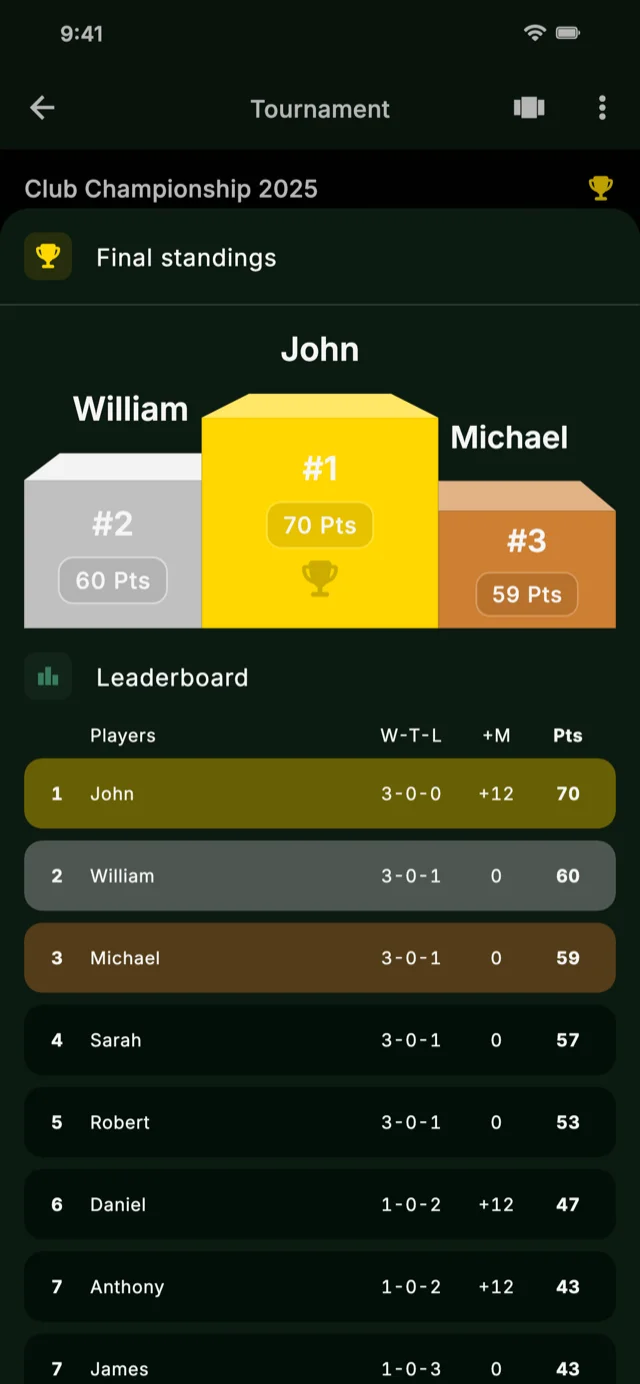
The standings can switch to average per match. Instead of the raw total, each player is ranked on their points divided by the number of matches they played. It is the fairest setting when playing time differs, and it can be changed at any point during the tournament.
You can try it for free and test these settings on your next tournament.
Byes per player by headcount
Values for a complete rotation, where every player partners with every other player exactly once.
| Players | Courts | Rounds | Matches played per player | Byes per player |
|---|---|---|---|---|
| 5 | 1 | 5 | 4 | 1 |
| 7 | 1 | 10 | 5 to 6 | 4 to 5 |
| 9 | 2 | 9 | 8 | 1 |
| 11 | 2 | 14 | 9 to 10 | 4 to 5 |
| 13 | 3 | 13 | 12 | 1 |
| 15 | 3 | 18 | 13 to 14 | 4 to 5 |
| 17 | 4 | 17 | 16 | 1 |
| 19 | 4 | 22 | 17 to 18 | 4 to 5 |
| 21 | 5 | 21 | 20 | 1 |
| 23 | 5 | 26 | 21 to 22 | 4 to 5 |
The pattern is clear. Headcounts shaped like 4 times the number of courts, plus one give a single bye per player. The other odd headcounts give four to five, which is still manageable but needs a careful split.
If your headcount falls into the second category and you have a spare court, open it. Moving 11 players from 2 to 3 courts drops the number of rounds, and the waiting time with it.
The player who arrives late or leaves early
This is the limit of a printed rotation sheet: it locks the headcount in at the moment it is printed. As soon as someone is missing or joins in, the plan is wrong and manual scoring becomes questionable.
Three tips to absorb this without breaking the evening:
- Lock the headcount at round 1, not at the invite stage. Wait five minutes if you need to, but generate the rotation on the people who are actually there.
- Decide in advance what a missed round is worth. That is exactly the role of the bye rule described above. A player who misses two rounds early in the evening is not penalized if they know what those rounds are worth.
- Rank on average per match as soon as the headcount shifts. A raw total is no longer comparable between someone who played 12 matches and someone who played 9.
Frequently asked questions
Can you run a pickleball tournament with 5, 7, 9 or 11 players?
Yes, all of these headcounts work. Some are even remarkably balanced. With 5 players on one court or 9 players on two courts, the rotation is complete and every player sits out exactly once across the whole tournament.
Who should sit out during a round?
Nobody in particular, and above all not always the same people. The principle is the circular waiting line: nobody sits out a second time before everyone has sat out once. An automatically generated rotation applies this rule while also accounting for partners and opponents already faced.
Does a player who sits out lose points in the standings?
It depends on your rule. If a round not played is worth zero, yes, and the final standings favor whoever played the most. The fix is to credit the bye, for example at half of a match’s total, or to rank players on their average points per match rather than their cumulative total.
Is it better to have an even or odd number of players?
Neither. What matters is the remainder of your headcount divided by 4, not whether it is even or odd. Nine players on two courts, an odd headcount, is more comfortable than ten players on two courts, an even headcount: one person waits instead of two.
Should the extra players be sent to a singles court?
No. Singles and doubles do not share the same pace or the same volume of points scored. Mixing the two makes scores incomparable and skews the final standings. A properly credited bye round beats a match of a different type.
How many courts should you open for an odd headcount?
Divide your number of players by four and round down. Eleven players call for two courts, thirteen call for three. If you can open one court more than that minimum, waiting time drops sharply.
Going further
The full breakdown of rounds, matches and byes for every headcount from 4 to 24 players is in the article on how many players a Mixer tournament needs. The scoring mechanism, including the bye rule, is covered in the Mixer scoring guide. For the general flow of the event, see the guide to organizing a pickleball tournament.
To get a fair rotation without doing the math, try Pickleball Mixer for free. Enter your headcount, even an odd one, and the rest follows.