 Pickleball Mixer
How many players for a pickleball Mixer tournament?
A pickleball Mixer tournament works from 4 players upward, with no upper limit. The real question is not the maximum, it is what your group size actually changes: how many courts to use, how many rounds to play, and who ends up sitting out. With exactly 4 players per available court, nobody ever rests. As soon as you move away from that multiple, the rotation has to spread out some bye rounds.
This article gives the exact numbers for every group size from 4 to 24 players.
The base rule: why multiples of 4 change everything
A doubles pickleball match uses 4 players on one court. The key question is simple: does your player count divide evenly by 4 times your number of courts?
In a Mixer, every player partners with every other player exactly once. That fixes the total number of matches needed for a full rotation:
Number of matches = n × (n − 1) ÷ 4, where n is the number of players.
With 8 players, that is 14 matches. With 12 players, 33 matches. With 16 players, 60 matches. Those matches are then spread across your courts, which is what determines the number of rounds.
Four situations come up, depending on the remainder when your group size is divided by 4:
✓ Perfect group size
Your player count is exactly 4 times your number of courts. The rotation is complete, nobody ever sits out, and the tournament lasts n − 1 rounds. That covers 4 players on 1 court, 8 on 2, 12 on 3, 16 on 4, 20 on 5, 24 on 6.
✓ Near-perfect group size
You have one player more than a perfect group size. The rotation stays complete and every player sits out exactly once, no more, no less. That covers 5 players on 1 court, 9 on 2, 13 on 3, 17 on 4, 21 on 5.
⚠️ Two or three players over
One pair will be missing from the rotation and bye rounds become uneven. This is not a blocker, but the bye rounds need to be managed, otherwise some players end up waiting noticeably longer than others.
This arithmetic is not a club convention, it is a constraint of combinatorics. No format escapes it.
From 4 to 7 players: the small group on one court
This is the setup for an impromptu get together, on a single court.
4 players. The ideal setup. Three rounds, three matches, and everyone has played with each of the other three. The full tournament fits in about twenty minutes. Nobody sits down.
5 players. Five rounds, five matches, each player plays four and sits out once. The distribution is perfectly balanced, which makes this a very good format despite the odd number.
6 players. Seven rounds for seven matches, but each player only plays four or five of them. Two to three bye rounds per person, which starts to mean a lot of waiting on a single court.
7 players. Ten rounds, and each player only plays five or six matches. Four to five bye rounds per player. At this point, a second court changes everything.
⚠️ The trap of one player too many on a single court
At 6 and 7 players on a single court, some players spend more than half their time watching. If you can open a second court, do it, even if it is not filled at every round.
From 8 to 11 players: the classic club night
This is the most common group size for a club night, and the one where the question of how many courts truly matters.
8 players on 2 courts. The reference setup. Seven rounds, 14 matches, every player plays all seven rounds without ever stopping. Everyone has played with everyone exactly once. Count on about two hours including warm up.
8 players on 1 court. The same 14 matches, but spread over 14 rounds. Each player plays seven and sits out seven times. It works over a long session, not for one evening.
9 players on 2 courts. Nine rounds, 18 matches, eight matches played per person and exactly one bye round each. One of the best possible balances for an odd number.
10 players on 2 courts. Eleven rounds, 22 matches, eight or nine matches per player and two to three bye rounds.
11 players on 2 courts. Fourteen rounds to complete the rotation, with four to five bye rounds per player. At this group size, a third court becomes clearly preferable.
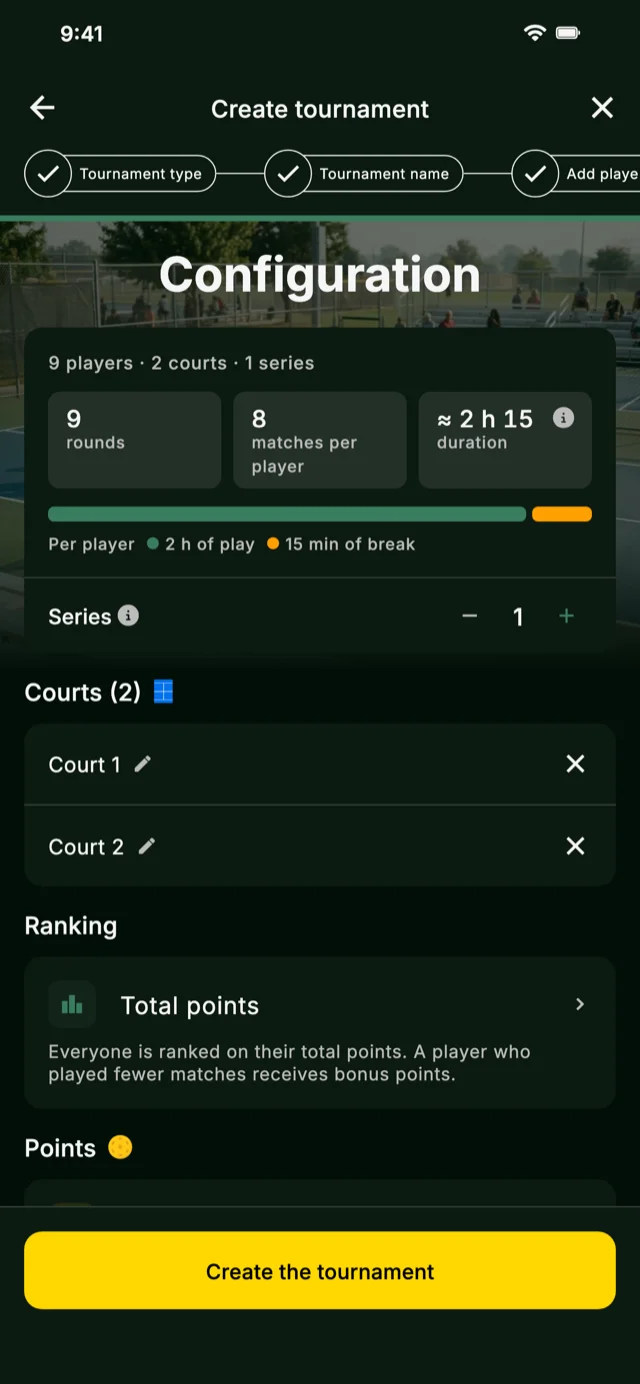
Generate the rotation without a chart with Pickleball Mixer
Working out by hand who plays with whom, on which court and in which round, while sharing out bye rounds fairly, becomes impractical past 8 players. A 12-player rotation is 33 matches to order under constraint.
Pickleball Mixer solves this ahead of time. Rotations are pre-computed by an optimization solver for every combination of players and courts, then bundled into the app. You enter your number of players and your number of courts, and the full schedule appears instantly.
The solver optimizes three things at once:
- Fairness of playing time. The gap between the player who plays the most and the one who plays the least is reduced to the minimum possible for your group size.
- Variety of opponents. For an equal number of matches, the rotation that has you facing the widest range of different people is preferred.
- Court usage. Every court stays in use every round for as long as the group size allows.
Three concrete advantages over a printed rotation sheet:
- The individual ranking updates live with every score entered, with no manual math.
- Bye rounds earn points. By default, a player who sits out a round is credited half the total of a match, so they do not drop in the ranking without deserving it.
- Players follow matches and the ranking from a shared link or a screen displayed via QR code.
You can try it for free and create your first tournament in a few minutes.
From 12 to 16 players: two to four courts
12 players on 3 courts. Perfect rotation. Eleven rounds, 33 matches, no bye rounds at all. This is the best setup for a group of this size.
12 players on 2 courts. The same 33 matches over 17 rounds, with six bye rounds per player. Noticeably less comfortable.
13 players on 3 courts. Thirteen rounds, 39 matches, a single bye round per person. An excellent compromise.
14 players on 3 courts. Fifteen rounds, 45 matches, two to three bye rounds per player.
15 players on 3 courts. Eighteen rounds, 52 matches, four to five bye rounds.
16 players on 4 courts. A perfect rotation again. Fifteen rounds, 60 matches, zero bye rounds.
From this group size onward, a full rotation becomes long. Most clubs only play part of it and stop the tournament after however many rounds fit in their time slot. The individual ranking stays valid, since it adds up points scored rather than matches won.
Beyond 16 players: large events
The perfect setups keep the same pattern: 20 players on 5 courts over 19 rounds, 24 players on 6 courts over 23 rounds. So do the single-bye setups: 17 players on 4 courts, 21 on 5, 25 on 6.
Two things to watch at these group sizes:
- The full rotation is no longer the goal. At 24 players, it means 138 matches. Set a number of rounds that fits your time slot instead, and stop there.
- The Mixer Team format becomes worth considering. With fixed pairs, every team faces every other team and the number of matches drops sharply. It is one of the variants covered in the tournament formats guide.
If your group has a wide range of skill levels, Competitive Mixer builds teams from the current ranking instead of at random, which tightens the scores. The comparison of the two format families details when to switch from one to the other.
Summary table by number of players
The values below correspond to a full rotation, where every player partners with every other player exactly once.
| Players | Recommended courts | Rounds | Matches | Bye rounds per player |
|---|---|---|---|---|
| 4 | 1 | 3 | 3 | 0 |
| 5 | 1 | 5 | 5 | 1 |
| 6 | 1 | 7 | 7 | 2 to 3 |
| 7 | 1 | 10 | 10 | 4 to 5 |
| 8 | 2 | 7 | 14 | 0 |
| 9 | 2 | 9 | 18 | 1 |
| 10 | 2 | 11 | 22 | 2 to 3 |
| 11 | 2 | 14 | 27 | 4 to 5 |
| 12 | 3 | 11 | 33 | 0 |
| 13 | 3 | 13 | 39 | 1 |
| 14 | 3 | 15 | 45 | 2 to 3 |
| 15 | 3 | 18 | 52 | 4 to 5 |
| 16 | 4 | 15 | 60 | 0 |
| 17 | 4 | 17 | 68 | 1 |
| 18 | 4 | 19 | 76 | 2 to 3 |
| 20 | 5 | 19 | 95 | 0 |
| 21 | 5 | 21 | 105 | 1 |
| 24 | 6 | 23 | 138 | 0 |
The simple rule to remember: a multiple of 4 means zero bye rounds, a multiple of 4 plus one means one bye round for everyone. The other two cases require rotating the bye rounds among players, so nobody sits out twice before everyone has sat out once.
Frequently asked questions
What is the minimum number of players for a pickleball Mixer tournament?
Four players. That is the minimum needed to form a doubles match, and it is enough for a full rotation in three rounds where everyone plays with each of the other three. Below four, no partner rotation is possible.
Is there a maximum number of players?
No. The only practical limit is the number of courts and how long your time slot is. Past about twenty players, do not try to play the full rotation: set a number of rounds that fits your schedule instead. The individual ranking stays fair since it adds up points scored.
What is the best number of players for a club night?
Eight players on two courts. Seven rounds, no bye rounds, everyone plays with everyone exactly once, and the whole thing fits in two hours including warm up. Twelve players on three courts offer the exact same qualities at a larger scale.
What happens if a player arrives late or leaves early?
A printed rotation sheet is fixed: it becomes wrong the moment the group size changes, and the manual ranking with it. The simplest fix is to plan the rule ahead of time, deciding how many points an unplayed round is worth. Pickleball Mixer applies half the total of a match by default, which neutralizes the effect of a missed round on the ranking.
Do you need an even number of players?
No. Odd group sizes work very well, and some are even remarkably balanced. Five players on one court, nine on two courts or thirteen on three courts each give every player exactly one bye round across the whole tournament.
How many courts do you need for X players?
Divide your number of players by four and round down. Twelve players call for three courts, and fourteen players also call for three. With fewer courts than that, the tournament is still playable but wait times increase sharply.
Going further
Your group size is set, the next step is running the event itself. The pickleball tournament organizing guide covers the six steps from choosing a format to closing out the results, and the round robin guide details the differences between fixed and rotating partners.
To generate your rotation without any math, try Pickleball Mixer for free. Enter your number of players and courts, and the full schedule plus live ranking follow automatically.