 Pickleball Mixer
How to Score a Pickleball Mixer Tournament
In a pickleball Mixer tournament, you don’t count matches won, you count points scored. Each match has a fixed total of points, split between the two teams according to the score. A player adds up the points scored across all of their matches, and this individual total sets the final ranking. It’s what makes it possible to rank players who changed partner every round.
This system has nothing to do with the score of a regular pickleball match. Here is exactly how it works.
The difference between a match score and a Mixer score
A regular pickleball match is played to 11 points with a 2 point lead, and only the serving team can score. The match stops when one team reaches the target. The result is binary: one team won, the other lost.
In a Mixer, that binary result isn’t enough. Each player changes partner every round, so their number of wins depends as much on the quality of their successive partners as on their own level. A consistent player who loses three times 11-9 has played better than an inconsistent player who wins twice 11-2 and loses once 11-0.
The Mixer solves this problem by counting points, not matches. Every point scored during the session stays credited to the player who scored it, regardless of the match’s outcome.
✓ The rule in one sentence
Your score for the session is the sum of the points your team scored in each of your matches. The final ranking sorts players by this total.
The fixed total per match, the key to the system
This is the point most organizers miss at first, and yet it’s the one that makes the ranking fair.
In a Mixer, a match isn’t played “to 11 points, win by two.” It’s played for a total of points to split. If you set a match to 24 points, both teams share exactly 24 points: 13-11, 16-8, 20-4, or even 24-0. The match stops when the sum of the two scores reaches 24.
The reason is arithmetic. With a “first to 11, win by two” format, a match can distribute 11 points in total (11-0) just as it can distribute 22 points (12-10). A player who happens to land on long matches would mechanically end up with more points to their credit than a player who lands on short matches, without having played any better. By fixing the total, every match carries exactly the same weight in the ranking.
⚠️ The classic mistake
Carrying over scores from matches played to 11 points, win by two, into a cumulative ranking. The totals are no longer comparable to each other, and the final ranking favors whoever played the closest matches.
How many points per match: 8, 11, 16, 21, 24, 32 or 40
Pickleball Mixer offers seven standard values, plus a custom value. The default value is 24 points per match.
The choice isn’t cosmetic. It determines how long your rounds last, and therefore how many partners each player will have during the session.
The durations below are based on the pace the app uses for its estimates: about 30 seconds per point in rally scoring, plus 3 minutes of downtime between two rounds to change court and partner.
| Total per match | Match duration | Round duration | What it gives you |
|---|---|---|---|
| 8 points | 4 min | 7 min | Very short rounds, lots of rotation, ideal for a large group |
| 11 points | 5 min 30 | 8 min 30 | The format closest to a regular pickleball match |
| 16 points | 8 min | 11 min | Good compromise for a two hour session |
| 21 points | 10 min 30 | 13 min 30 | Consistent rounds, fewer rotations |
| 24 points | 12 min | 15 min | Default value, balance between pace and substance |
| 32 points | 16 min | 19 min | Long matches, few rounds |
| 40 points | 20 min | 23 min | Reserved for long sessions with few players |
The logic behind the choice is simple:
- Lots of players, few courts: drop to 11 or 16 points. You run through more rounds, so everyone meets more people and rest times get shorter.
- Few players, a comfortable time slot: go up to 24 or 32 points. Matches have more substance and skill gaps smooth out.
- A mixed skill group: stay low. A short match limits the damage of an unbalanced pairing.
Rally scoring or side out: which one for a Mixer
The question comes up as soon as you announce a fixed total.
Traditional side out scoring, where only the serving team can score, stretches matches out considerably and makes their duration unpredictable. A string of side outs with no point scored can tie up a court for several minutes. In a tournament where every court has to finish at the same time to move to the next round, that’s a real problem.
Rally scoring, where every rally awards a point to its winner regardless of who served, suits a Mixer much better. The number of rallies needed to reach the total is known in advance, so a round’s duration is predictable and every court frees up at roughly the same time.
This is why the majority of social partner rotation formats have adopted rally scoring. The basics of scoring in a regular match are covered in the pickleball rules for beginners guide.
How Pickleball Mixer keeps score for you
Adding up every player’s points over an entire session is doable by hand, but tedious and error prone. With 12 players over 11 rounds, that’s 132 lines to carry over, and just as many chances to get it wrong.
Pickleball Mixer automates the whole chain:
- You set the total per match when you create the tournament, from among the seven standard values or a custom value.
- You enter a single score per match. The opposing score is deduced automatically from the total, so there are never two numbers to enter, and no risk of inconsistency.
- The ranking recalculates on every entry. Points get added to each of the four players’ running totals in real time.
- Players follow the ranking live, from a shared link or a screen displayed via QR code.
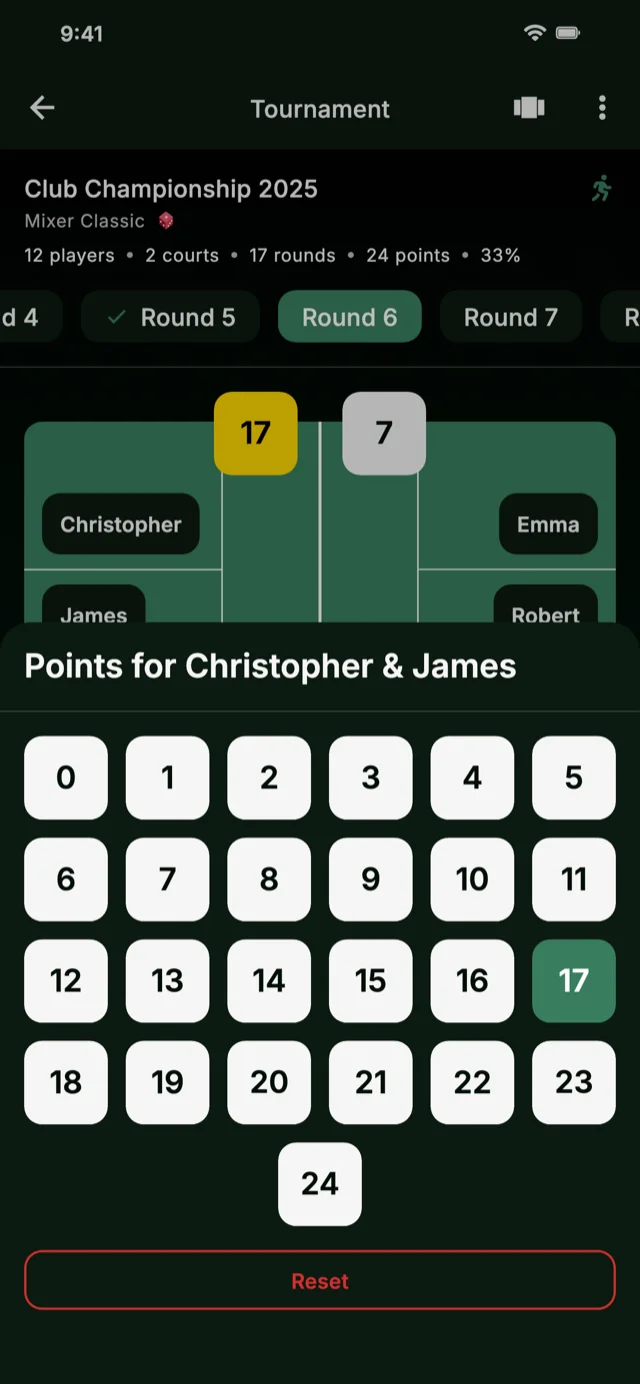
The app also offers two ranking modes, which changes how the final table reads:
- Total points. The raw sum of points scored. This is the natural mode when everyone plays the same number of matches.
- Average per match. The total divided by the number of matches played. Essential as soon as players haven’t all played the same number of rounds, for example with an odd number of players or a player who arrived late.
You can try it for free and create a tournament with your own scoring.
A full worked example over four rounds
Take 8 players on 2 courts, with matches to 24 points. Let’s follow one player, call them player A.
| Round | Partner | Opponents | Score | A’s points |
|---|---|---|---|---|
| 1 | B | C and D | 16-8 | 16 |
| 2 | E | F and G | 10-14 | 10 |
| 3 | C | H and B | 13-11 | 13 |
| 4 | F | D and E | 9-15 | 9 |
Player A’s total after four rounds: 48 points, an average of 12 points per match.
Three things to note about this example:
- A only won two out of four matches, but their total stays solid because they scored even in the matches they lost. A player who won twice 24-0 and lost twice 0-24 would show the same total of 48, with far less consistency.
- The partner factors into the score, but they change every round. Over a full rotation, the effect of good and bad partners evens out.
- Each match distributes exactly 24 points between the two teams. Over the four rounds, 96 points were put into play in total, every time.
Handling ties in the final ranking
Two players can finish with the same total. Pickleball Mixer then applies a cascade of tiebreakers, in this order:
- Number of matches won. At equal points, whoever converted their points into wins ranks higher.
- Number of matches drawn.
- Number of matches lost.
- Point difference, meaning points scored minus points conceded.
This cascade settles nearly every case. It has the advantage of being announced in advance and applied without discussion, which avoids end of session arguments.
If you’re keeping the ranking by hand, announce your tiebreaker criterion before the first round, not once a tie appears.
The special case of the Competitive Mixer
The point counting is identical, but it also serves another purpose.
In a regular Mixer, each round’s teams are formed randomly and the schedule is fixed in advance. In a Competitive Mixer, the next round’s teams are formed based on the current ranking: first place plays with fourth against second and third, and so on.
The score is therefore no longer just a counter, it drives the pairings. One practical consequence: in a Competitive Mixer, scores absolutely must be entered before starting the next round, otherwise the teams can’t be calculated. The detailed comparison of the two formats explains when one is better than the other.
Frequently asked questions
How are points counted in a pickleball Mixer tournament?
Each match has a fixed total of points, for example 24, split between the two teams according to the final score. Each player adds the points scored by their team to their personal total. The final ranking sorts players by this total, not by the number of matches won.
Do you have to play to 11 points like a normal match?
Not necessarily, and it isn’t the most common choice. In a Mixer, 11 refers to the total to split between the two teams, not a target to reach first. A match can therefore end on a 7-4 or a 9-2. Pickleball Mixer’s default value is 24 points, which gives rounds of about twelve minutes.
Is rally scoring mandatory in a Mixer?
It isn’t mandatory, but it’s strongly recommended. Since the match stops at a total known in advance, rally scoring makes round duration predictable and lets every court free up at roughly the same time. Side out scoring stretches matches out unpredictably and throws off the rotation.
How do you rank players who haven't played the same number of matches?
By switching the ranking to average points per match rather than the total. The total mechanically favors whoever played the most. This is the typical situation with an odd number of players, where some players rest more often, or with a player who arrived after the first round.
What happens when there's a tie in points on the ranking?
The criteria apply in order: number of matches won, then number of matches drawn, then number of matches lost, then point difference. Always announce your tiebreaker rule before the tournament starts if you’re keeping the ranking by hand.
Can a player who loses every match still rank well?
Yes, and it’s a deliberate feature of the format. On matches to 24 points, a player who loses all four of their matches 11-13 totals 44 points. A player who wins two 13-11 and loses two 2-22 only totals 30, despite their two wins. The first player finishes ahead of the second. The format rewards consistency over a simple binary result.
Going further
The points scale sets the length of your rounds, and therefore what fits into your time slot. The pickleball round robin guide covers how to chain these rounds together, and the organizing guide walks through the whole event from start to finish. To size your group, the article on how many players gives the rounds and rest times for each headcount.
To stop adding up columns by hand, try Pickleball Mixer for free. Enter one score per match, and the ranking updates itself.