 Pickleball Mixer
How long does a pickleball tournament last?
A Mixer format pickleball tournament lasts exactly as long as you decide. The duration is not something you suffer through, it is something you calculate ahead of time from three settings: the number of points per match, the number of courts, and the number of rounds. Count roughly 30 seconds per point played, plus 3 minutes of changeover between two rounds. A match to 24 points therefore occupies a court for 15 minutes, changeover included.
The right question is not how long a tournament lasts, but how many rounds fit into your time slot.
The four variables that determine duration
None of these variables are fixed by the rules. All of them are set before the first serve.
- The total points per match. This is the main lever. A match ends when the sum of both teams’ scores reaches the set total. At 30 seconds per point in rally scoring, a match to 11 points lasts 5 min 30 sec, a match to 24 points lasts 12 min.
- The changeover time between rounds. Players need to switch partners, move to the right court, and log the score. Three minutes is realistic for an organized group. Five minutes is closer to reality for a relaxed club night.
- The number of courts. It does not change the length of a round, but it changes how many rounds are needed for everyone to play with everyone else.
- The number of rounds played. This is the adjustment variable. Nothing forces you to play the full rotation.
✓ The formula to remember
Round length = (points per match × 30 seconds) + 3 minutes changeover
Total duration = round length × number of rounds
The number of courts does not enter into the round length calculation, since all courts play in parallel.
Round length by your scoring format
| Points per match | Play time | Full round |
|---|---|---|
| 8 | 4 min | 7 min |
| 11 | 5 min 30 sec | 8 min 30 sec |
| 16 | 8 min | 11 min |
| 21 | 10 min 30 sec | 13 min 30 sec |
| 24 | 12 min | 15 min |
| 32 | 16 min | 19 min |
| 40 | 20 min | 23 min |
These figures are for rally scoring, where every rally scores a point regardless of who served. In traditional side-out scoring, where only the serving team can score, count noticeably more time and, above all, expect unpredictability: a run of side-outs with no points ties up a court with no way to anticipate the end. For a tournament where every court needs to finish together, rally scoring is the sensible choice.
How many rounds fit in your time slot
Divide your available play time by the round length.
For a 2 hour slot, setting aside 10 minutes for check-in and warm-up, you are left with 110 minutes of actual play time:
| Points per match | Round length | Rounds in 110 minutes |
|---|---|---|
| 8 | 7 min | 15 |
| 11 | 8 min 30 sec | 12 |
| 16 | 11 min | 10 |
| 21 | 13 min 30 sec | 8 |
| 24 | 15 min | 7 |
| 32 | 19 min | 5 |
| 40 | 23 min | 4 |
For a 90 minute slot, with 80 minutes of actual play time: 11 rounds to 8 points, 9 rounds to 11 points, 7 rounds to 16 points, 5 rounds to 24 points.
Fitting a 2 hour night: three worked examples
8 players on 2 courts
A full rotation needs 7 rounds, at the end of which everyone has played with each of the seven others exactly once and no one has ever sat out.
- At 24 points per match: 7 rounds × 15 minutes = 105 minutes. The full rotation fits just inside the 110 minutes available. This is the setting to prefer, it gives a night that wraps up cleanly with a complete standings.
- At 16 points per match: 7 rounds × 11 minutes = 77 minutes. You finish the rotation with over 30 minutes to spare, enough to run a second series.
12 players on 3 courts
A full rotation needs 11 rounds and 33 matches, with no one ever resting.
- At 24 points: 11 rounds × 15 minutes = 165 minutes. That does not fit. You would play 7 rounds out of 11.
- At 16 points: 11 rounds × 11 minutes = 121 minutes. Still a bit long, you would play 10.
- At 11 points: 11 rounds × 8 min 30 sec = 94 minutes. The full rotation fits, with room to spare.
At this headcount, lowering the scoring format is what lets you complete the full rotation.
16 players on 4 courts
A full rotation needs 15 rounds. Even at 8 points per match, that is 105 minutes, the entire slot with no margin at all.
The right move here is not to compress further, but to accept a partial rotation. Set 9 rounds to 11 points, which is 76 minutes, and stop there. The individual standings remain perfectly valid, since it adds up points scored rather than matches won. Everyone will have played 9 matches with 9 different partners, which is more than enough for one night.
⚠️ The most common mistake
Starting a full rotation at 24 points with 16 players, then having to cut the tournament off mid round because the slot runs out. The standings end up skewed, since some players will have played one more match than others. Decide on the number of rounds before the first serve, not during.
Planning duration in Pickleball Mixer
Pickleball Mixer does this calculation for you and displays it before you launch anything.
When you create a tournament or add a series of rounds, the app estimates:
- The length of a match and of a round, changeover included.
- The total duration of the proposed series.
- Each participant’s actual play time, meaning the time spent on court.
- The waiting time, the difference between the two.
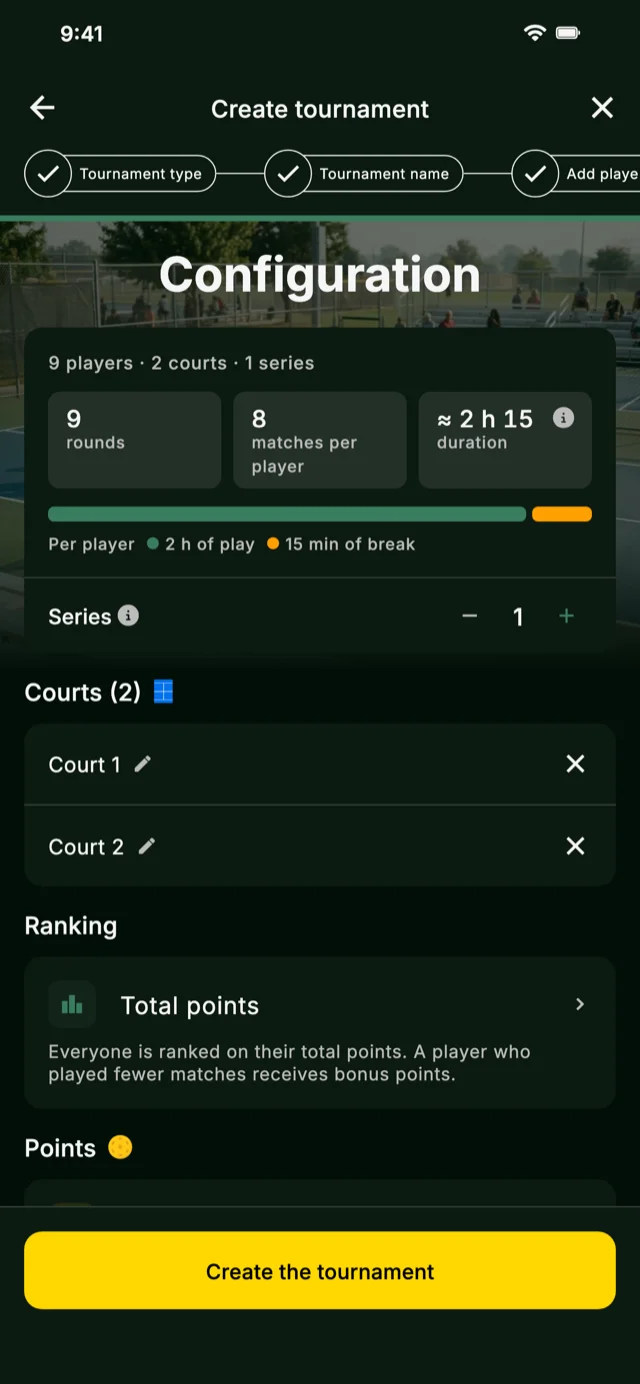
This distinction between total duration and actual play time is what hand made schedules are missing most. On a 110 minute night with 11 players on 2 courts, the total duration is the same for everyone, but the time actually spent playing is not. Seeing both numbers side by side before you confirm avoids discovering the problem in the third round.
The scoring format is set in the same place, so you can adjust the target duration in one move and immediately see how many rounds fit.
You can try it for free and size your next night in a few seconds.
What throws off the schedule and how to avoid it
Courts that do not finish together. A round only ends once the last court has finished. If one match drags on, every other court waits. A fixed points total strongly limits this risk, since every match ends at a known number of rallies, unlike a win by two format.
Manual score tallying. Adding up columns on a sheet between rounds adds several minutes to every changeover. Over 10 rounds, that easily wastes 20 minutes. A single score entry that updates the standings by itself removes this cost entirely.
Unstructured warm-up. Announce a first serve time, not a meeting time. The ten minutes of check-in need to be part of your calculation, not added on top.
Late arrivals. Generate the rotation using the players actually present at the first round. A schedule built on a theoretical headcount will be wrong all night. This point is covered in the article on an odd number of players.
Frequently asked questions
How long does a pickleball match last in a Mixer tournament?
About 30 seconds per point in rally scoring. A match to 11 points lasts 5 min 30 sec, a match to 24 points about 12 minutes. Adding 3 minutes to switch partners and courts, a full round takes 8 min 30 sec and 15 minutes respectively.
How many rounds can you play in 2 hours?
Setting aside 10 minutes for check-in, you have 110 minutes of play left. That is 7 rounds at 24 points per match, 10 rounds at 16 points, or 12 rounds at 11 points. The number of courts does not change this result, since all courts play at the same time.
Does the number of courts change the tournament's duration?
Not the length of a round, since courts play in parallel. It does change how many rounds are needed for everyone to play with everyone. Eight players on two courts complete a full rotation in 7 rounds, versus 14 rounds on a single court.
Do you have to play the full rotation?
No, and it is often not recommended above 12 players. A Mixer’s standings add up points scored, not matches won: they stay fair even if the rotation stops partway through, as long as every player has played the same number of matches. Just set the number of rounds ahead of time.
How do you shorten a tournament that looks like it will run too long?
Lower the total points per match before starting. Going from 24 to 16 points saves 4 minutes per round, or 40 minutes over 10 rounds. That is far more effective than cutting into changeover time, which is actually needed to switch courts and catch a breath.
How much time should you plan for 20 players?
A full rotation for 20 players on 5 courts needs 19 rounds, nearly 5 hours at 24 points per match. That is not a club night format. Plan instead for 8 to 10 rounds at 11 or 16 points, which fits in 2 hours and still gives everyone plenty of different partners.
To go further
The scoring format drives the duration, but also how the standings are built. The guide to scoring in a Mixer explains why a match’s total is fixed and how that makes scores comparable. The number of rounds for a full rotation at each headcount is in the article on player count, and the general event flow is in the organizing guide.
To see the estimated duration before you launch your tournament, try Pickleball Mixer for free.