 Pickleball Mixer
Pickleball round robin generator: printable sheet, spreadsheet, or app
Four methods coexist for organizing a pickleball round robin: the printed rotation sheet, the homemade spreadsheet, the online generator, and the dedicated app. None of them is the best choice in every case. A printed sheet still suits a fixed group of 8 players that never changes. The choice shifts as soon as your player count is uncertain, you want a live ranking, or you go past a dozen participants.
Here is what each method does well, and what it cannot do.
What a rotation has to produce
Before comparing tools, it helps to agree on the actual job. Generating a Mixer rotation is not just spreading names across courts. It means satisfying four constraints at once:
- Every player partners with every other player exactly once, when possible.
- Opponents vary as much as possible, so nobody faces the same person three times.
- Rest time is shared fairly, so nobody sits out twice before everyone has sat out once.
- Every court stays occupied every round.
These constraints pull against each other. Optimizing all four at once is a combinatorial problem, which is why a 12 player rotation means ordering 33 matches, not just scrolling through a list.
A fifth requirement sits on top, and it belongs to running the event rather than generating it: keeping the ranking up to date while play is happening.
The printed rotation sheet
This is the traditional method, and it has real strengths. Ready made charts exist for the most common group sizes, generally 8 to 16 players, to print and fill in by pen.
What it does well. No dependency on network or battery. Everyone can see the schedule pinned on the wall. For a stable group of 8 players on 2 courts who meet every week, it is hard to beat for simplicity.
Where it breaks down. The schedule is fixed the moment it is printed. If two people cancel, the sheet is wrong and you have to start over. Available group sizes are limited to whatever someone bothered to calculate, rarely past 16 and rarely for odd numbers. And above all, the ranking stays entirely manual: columns have to be added by hand between rounds, which stretches every break by several minutes.
✓ When a printed sheet is genuinely enough
A fixed group, a player count known in advance that never changes, 8 to 12 players, no cumulative ranking to keep or one you are fine calculating at the end. In that exact setup, do not change anything.
The homemade spreadsheet
This is the natural temptation for the methodical organizer: rebuild the rotation in a spreadsheet and let formulas handle the addition.
What it does well. The ranking calculates itself once the formulas are in place. Columns adapt to any scoring scale. The file gets reused week after week.
Where it breaks down. A spreadsheet adds, it does not optimize. Each round’s pairings have to be entered by hand, and that is precisely the hard part. Nobody composes by hand a 14 player rotation that satisfies the four constraints above: what results looks correct and, in practice, has the same partners playing together three times while the same people always end up on the bench.
There is also the reality on the ground: entering scores into a spreadsheet on a phone, standing at courtside, between rounds, is a miserable experience. The file ends up open on a laptop sitting on a bench, held by the one person who is not really playing anymore.
⚠️ The hidden cost of the spreadsheet
The time spent designing the file is paid once, but the time spent entering data is paid every round, by the same person, for the whole evening. That is often the organizer, meaning someone who came to play.
The online generator
Several websites generate pickleball round robin schedules for free, to print or export. This is real progress over the two previous methods.
What they do well. Generation is instant and covers far more group sizes than a ready made sheet. Rotations are generally built correctly, with a fair spread of rest turns. PDF or spreadsheet export lets you personalize names.
Where they break down. These are static tools. They produce a schedule before the event, then their job is done. Three concrete consequences:
- The ranking is not kept. You are left with a blank grid to fill in by pen, meaning the same manual addition as the paper scenario.
- The schedule does not adapt. If the actual turnout differs from what was entered the night before, you have to regenerate and reprint.
- Nothing is shared with players. Participants cannot check their next match or the ranking from their phone.
An online generator solves the first half of the problem, composing the matches, and leaves the second half untouched: running the evening.
The dedicated app
This is the only category that covers both halves of the problem.
Pickleball Mixer generates the rotation from brackets pre calculated by an optimization solver, for every combination of players and courts. The solver minimizes the gap in playing time between participants, maximizes opponent variety, and keeps courts occupied. This work happens ahead of time, so the display is instant on the phone.
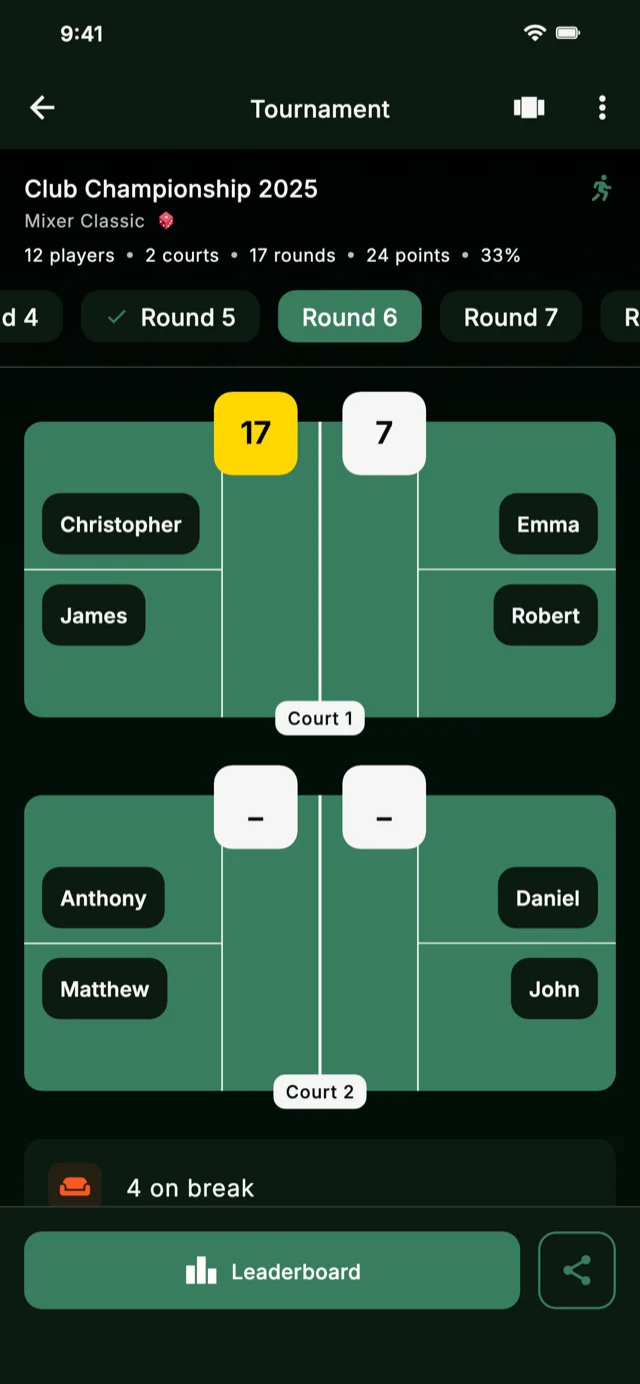
What the app adds compared to a printed schedule:
- A single score to enter per match. The opponent’s score is deduced from the configured total, so no double entry and no possible inconsistency.
- A ranking recalculated on every entry, with two reading modes: total points or average per match. The second is essential when players have not all played the same number of rounds.
- Bye rounds that earn points. An unplayed round is credited, by default at half the total of a match, which neutralizes its effect on the ranking.
- A duration estimate before starting, which separates total duration from each participant’s actual playing time.
- Live sharing, through a public link or a display screen via QR code.
- Offline operation during matches, useful in poorly covered gyms.
- Six formats, from the classic Mixer to the Competitive Mixer that recomposes teams based on the current ranking, through fixed pair and mixed pair variants.
Where it breaks down. It needs a charged phone and someone to enter scores. For a group of 8 people who always play the same rotation and keep no ranking, that is more tooling than necessary.
You can try it for free before deciding.
Comparison table of the four methods
| Printed sheet | Spreadsheet | Online generator | App | |
|---|---|---|---|---|
| Optimized match composition | Depends on the sheet | No, manual | Yes | Yes |
| Group sizes covered | Limited | All, by hand | Broad | All |
| Odd numbers handled | Rarely | By hand | Variable | Yes |
| Fair rest time distribution | Depends on the sheet | By hand | Generally | Yes |
| Automatic ranking | No | Yes, after entry | No | Yes |
| Points for an unplayed round | No | To define | No | Yes |
| Adapts on the night | No | Partial | No | Yes |
| Shared with players | Wall display | No | No | Link and QR code |
| Works offline | Yes | Yes | Not to generate | Yes |
| Duration estimate | No | By hand | No | Yes |
How to choose based on your situation
Fixed group of 8 players, 2 courts, always the same. A printed sheet is enough. You reuse it every week and the ranking is easy to keep in your head.
Turnout that varies from week to week. An online generator or an app. A printed sheet will be wrong every other week.
You want a live ranking and a podium announced at the end of the night. An app. It is the only option that keeps the running total without tying up someone for the whole evening.
More than 12 players. An app or a generator. Past this group size, composing rounds by hand is no longer realistic and fairness errors become visible.
Odd number of players. An app. This is where managing bye rounds and compensating for them in the ranking makes the biggest difference, as detailed in the article on odd numbers of players.
You are organizing for a club, not for yourself. An app. The deciding argument is not generation, it is sharing: players check their next match and the ranking without having to ask.
Frequently asked questions
Are there free printable pickleball round robin sheets?
Yes, several websites offer them, mainly for 8 and 12 players. They suit a stable group whose size is known in advance. Their limits are a narrow choice of group sizes, no version for most odd numbers, and a ranking that stays entirely to be calculated by hand.
Can you run a pickleball rotation in Excel?
You can keep scores there and calculate a ranking, but you cannot generate a correct rotation there. A spreadsheet adds, it does not optimize: each round’s pairings have to be entered by hand, and that is precisely the hard part once you pass about ten players.
What is the difference between an online generator and an app?
A generator produces a schedule before the event, then stops there. An app also carries the evening itself: score entry, a ranking recalculated live, compensation for unplayed rounds, sharing with players. The generator solves match composition, the app also solves the evening.
Do you need network access to run a tournament?
Not to play. Pickleball Mixer works offline during matches, which matters in poorly covered gyms. A connection is only needed to share the live ranking with players who are away from the venue.
How do you handle a player who cannot play every round?
By deciding in advance what an unplayed round is worth. A printed schedule has no answer to that question, so it gets settled at the end of the night and is open to argument. An app applies an announced rule, for example crediting half the total of a match, or ranking players on their average per match rather than their cumulative total.
Which method works for a club tournament with 20 players?
An app. At that group size, a complete rotation means 95 matches over 19 rounds, which is far more than one evening and rules out any manual composition. You need to be able to set a number of rounds that fits your time slot and keep a fair ranking over a partial rotation.
Going further
The choice of method depends first on your player count and your time slot. The article on how many players a Mixer tournament needs gives the rounds and rest turns for every group size, and the one on how long a tournament lasts explains how to fit a two hour evening. For the full run of the event, see the guide to organizing a pickleball tournament.
To compare for yourself, try Pickleball Mixer for free and generate a rotation with your actual turnout.